Academics use London Tube map to model options for nuclear fuel cycle
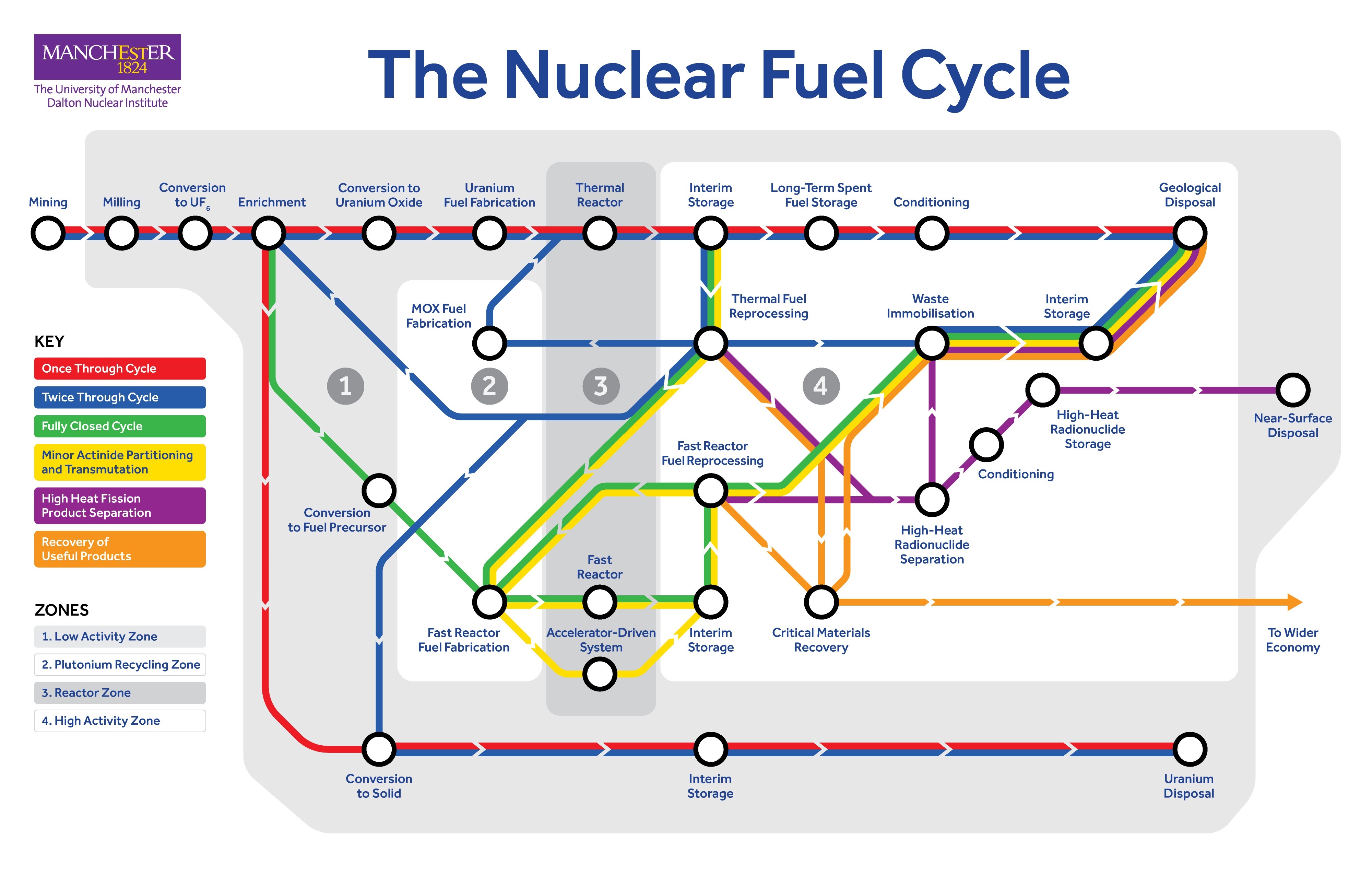
A new review paper from the Dalton Nuclear Institute at 51福利社 uses a Tube map design to examine how closing the nuclear fuel cycle - recycling and reusing materials from used fuel - improves the sustainability of nuclear energy.
Titled '', the review compares six fuel cycle pathways of varying complexity, from the simplest once-through cycle where all spent fuel is treated as waste, to more advanced options incorporating multiple stages of recycling.
To make the comparison accessible, the authors present the six options as a 鈥楾ube map鈥�, modelled on the London Underground - a first for the field.
Today鈥檚 nuclear reactors already compare well with renewable technologies when it comes to many sustainability metrics. However, this review finds that closing the fuel cycle could improve sustainability further still, delivering benefits for natural resource use, environmental footprint, management of high-level radioactive waste, and energy security.
Co-author Professor Robin Taylor, of the Dalton Nuclear Institute and the UK National Nuclear Laboratory, said: 鈥淐losing the fuel cycle does come with real challenges, including those around safety, security, and cost. However, by drawing on the UK鈥檚 own experience as a case study, our review finds that these challenges can be addressed and do not necessarily rule out the benefits of reusing nuclear fuel鈥�.
Co-author Dr William Bodel, of the Dalton Nuclear Institute, added: 鈥淥ur review shows that while nuclear energy is already a sustainable source of low-carbon energy, successfully closing the fuel cycle could enhance this further. Visualising various fuel cycle options together is hard given the amount of information which needs to be presented simultaneously. Harry Beck鈥檚 1930s London Underground map does an excellent job at communicating complicated information, so applying its design here seemed a good solution to aid visual understanding.鈥�
Read the full review:
The review was authored by:
- Dr William Bodel
- Professor Anthony Banford
- Professor Gregg Butler
- Professor Francis Livens
- Professor Robin Taylor