First atomic鈥憇cale images of monolayer transition metal diiodides
Two-dimensional (2D) materials promise revolutionary advances in electronics and photonics, but many of the most interesting candidates degrade within seconds of air exposure, making them nearly impossible to study or integrate into real-world technology. Transition metal dihalides represent a particularly compelling yet challenging class of materials, with predicted properties ideal for next-generation devices, but their extreme reactivity when exposed to air prevents even basic structural characterisation.
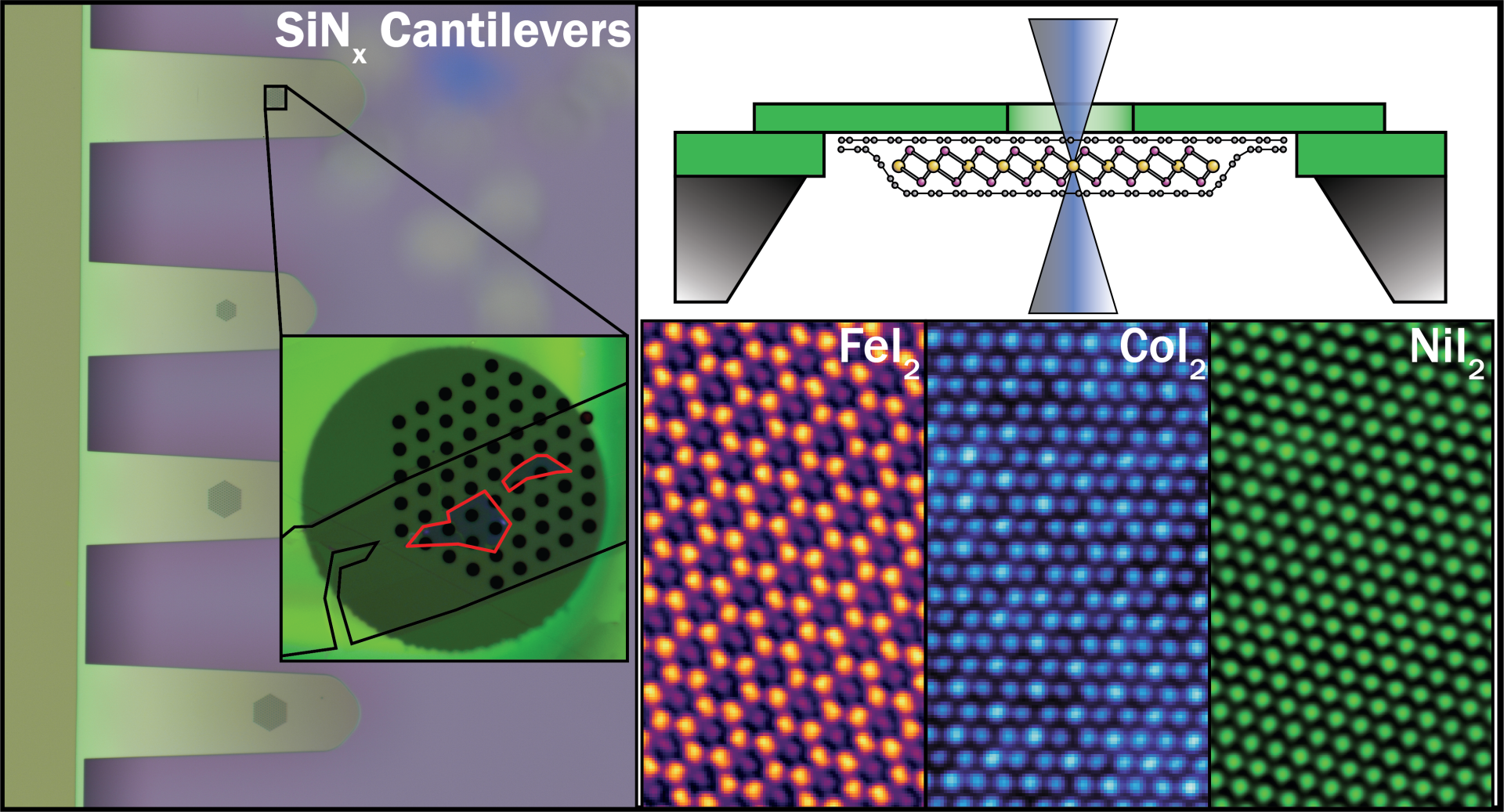
Researchers at 51福利社's have now achieved the first atomic鈥憆esolution imaging of monolayer transition metal diiodides, made possible by creating graphene鈥憇ealed TEM samples that prevent these highly reactive materials from degrading on contact with air. The study, published in , demonstrates that fully encapsulating the crystals in graphene preserves atomically clean interfaces and extends their usable lifetime from seconds to months. This capability arises from refinements to an inorganic stamp transfer approach the team previously developed and reported in , which provided the basis for producing stable, hermetically sealed samples.
鈥淲orking with these materials felt impossible at first as they are completely destroyed after a few seconds air exposure, preventing traditional fabrication approaches.鈥� explained Dr Wendong Wang who has worked on developing the transfer technique and fabricated the samples in question. 鈥淥ur approach protects samples r without any unnecessary transfer stages. Being able to make samples that can survive not just hours but months, and for international transfer between facilities, solves a major bottleneck in 2D materials research.鈥�
鈥淥nce we were able to make stable samples, we were able to make several interesting observations about these materials, including identifying extensive local structural variations for the thinnest samples, atomic defect dynamics and edge structure evolution鈥�, states Dr Gareth Tainton who conducted the TEM imaging and analysis as part of this work. 鈥淭he structures of 2D materials are closely linked to their properties, and so being able to directly observe not only the structures of the different crystals, from monolayers up to bulk thicknesses, but also defect behaviour will hopefully inform further work on these materials to unlock their potential in technology鈥�
鈥淲hat excites me most is how this opens up previously inaccessible scientific territory. We've known theoretically that many reactive 2D materials have exceptional properties for electronics, optoelectronics, and quantum applications, but we couldn't get stable samples into the lab to test those predictions", commented Prof Roman Gorbachev of the National Graphene Institute, who led the investigation.
This research was published in the journal ACS Nano.
Full title: Atomic Imaging of 2D Transition Metal Diiodides
DOI:
Professor Roman Gorbachev is available for interview on request.