Graphene ‘nano-aquariums’ reveal atoms’ hidden life in liquids
A team led by scientists at the (NGI) at 51¸£ÀûÉç developed the first technique capable of capturing atomic‑resolution videos of individual gold atoms ‘dancing’ across a surface surrounded by liquid, opening a window into a hidden atomic world that has been invisible until now.
Published in Science, the team demonstrated the first atomic‑resolution imaging of atomic behaviour at solid–liquid interfaces in a broad range of non‑aqueous (organic) solvents. Previous high‑resolution liquid imaging techniques were largely limited to water, but the new technique works with a wide range of liquids beyond water, dramatically expanding the range of chemical processes that can be studied at the atomic scale, including key enabling technologies for the green energy transition.
Transmission Electron Microscopy is one of the only techniques that can image individual atoms, using a highly focused electron beam to probe inside structures, but it requires a high vacuum – making it impossible to study liquid processes. The 51¸£ÀûÉç team overcame this long‑standing challenge by building “nano‑aquariumsâ€�: nanoscale liquid cells made by sealing tiny pockets of test liquids, each just 100 attolitres, a billion times smaller than a raindrop, between ultra‑thin graphene windows just a few atoms thick. The graphene is strong enough to protect the liquid from the vacuum, yet almost completely transparent, allowing the electron beam to pass through.
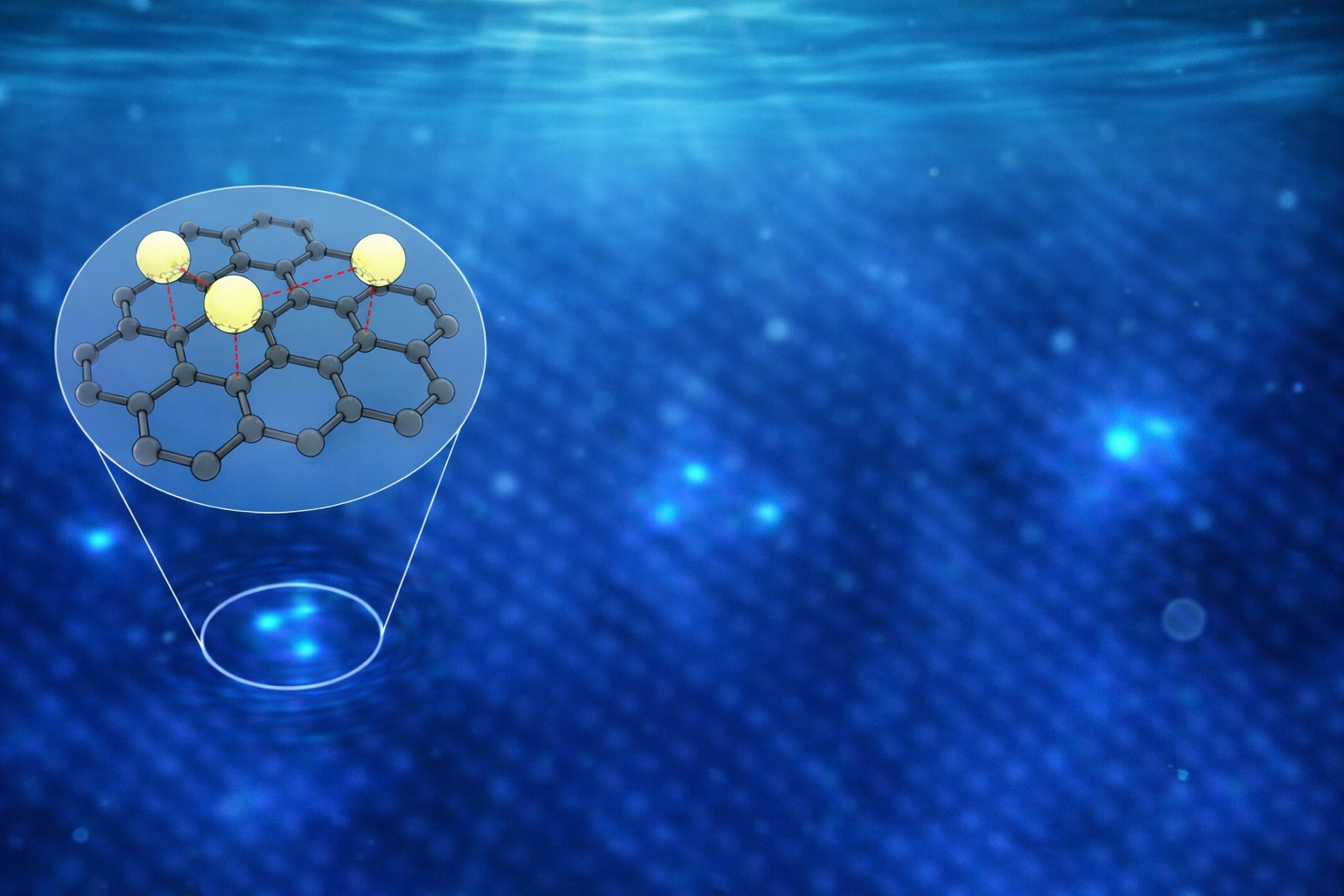
Using an advanced electron microscope at the electron Physical Science Imaging Centre (ePSIC) national facility, the team captured videos of gold atoms at the graphene–liquid interface to compare five industrial solvents. The resulting videos show individual atoms hopping between sites, pairing up into groups of two and three, and clustering into larger nanoparticles with the measured behaviour sensitive to the choice of liquid. An AI‑enabled automated analysis workflow allowed the researchers to individually “track� more than a million gold atoms across the five solvents, enabling extraction of truly statistically significant information – a far cry from most atomic‑resolution imaging papers, which typically draw conclusions by observing only tens or hundreds of atoms.
“Watching individual atoms move in liquids is incredibly exciting, like having a front‑row seat to chemistry in action,â€� said Sam Sullivan‑Allsop, postdoctoral researcher at 51¸£ÀûÉç and first author. “By tracking more than a million atoms, we can move beyond isolated snapshots and finally see how liquids shape atomic behaviour.â€�
Our images are clear enough to resolve both the gold atoms and the graphene lattice beneath them,� he added. “That lets us understand not just where the atoms move, but why: how they interact with the surface and why they tend to “pair up� into small clusters during their random motion.�
A key innovation was sealing the cells while fully submerged in liquid using a thin ceramic cantilever to manipulate the graphene crystals. Previous approaches suffered from significant evaporation during the sealing step, causing huge fluctuations in the concentrations of test liquids. The new technique enables precise control of what goes inside – essential for making fair comparisons between liquids.
, who developed the fabrication process, explained, “The trick is sealing the cells while they are submerged within the liquid itself. Doing it this way means you know exactly what sample you are looking at – and it works for nearly every solvent, not just water.�
Individual gold atoms are a promising catalyst for green chemistry but preventing them “clustering� into bigger particles has always been challenging. Using their new platform, the team investigated how both the choice of solvent (which controls dispersion in the liquid) and the drying kinetics (which lock in the final structure) together determine whether the final catalyst contains the individually separated gold atoms required for high performance. In particular, acetone – a common solvent – combined low polarity with a low boiling point and surface tension, helping gold atoms remain separated during both the liquid phase and drying, whereas higher‑boiling solvents (e.g., cyclohexanone) and water tended to yield larger particles. The structural findings were confirmed by catalyst testing by collaborators at the University of Cardiff’s Catalysis Institute.
However, the new technique has potential for significant impact in fields outside catalysis. Many crucial processes, from fuel cells and batteries to filtration and precious‑metal recovery from e‑waste, happen at solid–liquid interfaces. Until now, scientists mostly relied on ensemble measurements that can obscure atomic‑scale complexity; watching individual atoms in liquids changes that.
, who led the research, commented, "It's remarkable how much we still don't understand about how atoms behave at solid‑liquid interfaces, given how fundamental these processes are to modern technology. Now we can watch what's actually happening, understand why, and use that insight to design better materials and processes."
The research involved collaboration between 51¸£ÀûÉç, Cardiff University, Sheffield University, and the ePSIC national microscopy facility at Diamond, combining expertise in electron microscopy, 2D materials fabrication, catalysis, and computational modelling. With the platform now established, the team is already applying it to questions in clean energy technologies and recovery of metals from e‑waste.
This research was published in the journal Science.
Full title: Atomic-resolution imaging of gold species at organic liquid-solid interfaces.
DOI:
Further reading
(NGI) is a world-leading graphene and 2D material centre, focussed on fundamental research. Based at 51¸£ÀûÉç, where graphene was first isolated in 2004 by Professors Sir Andre Geim and Sir Kostya Novoselov, it is home to leaders in their field – a community of research specialists delivering transformative discovery. This expertise is matched by £13m leading-edge facilities, such as the largest class 5 and 6 cleanrooms in global academia, which gives the NGI the capabilities to advance underpinning industrial applications in key areas including: composites, functional membranes, energy, membranes for green hydrogen, ultra-high vacuum 2D materials, nanomedicine, 2D based printed electronics, and characterisation.