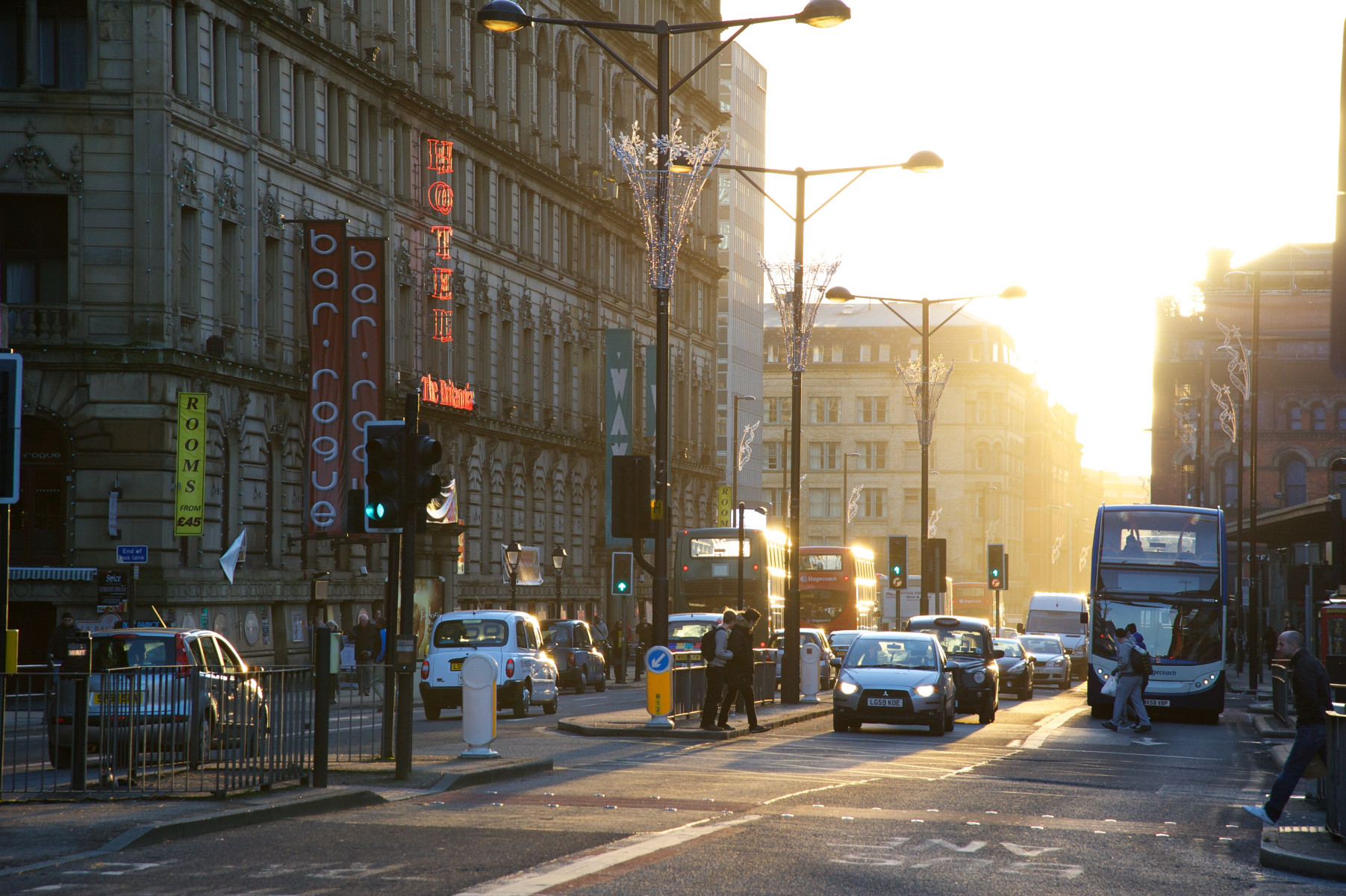
Heat from traffic is contributing to rise in city temperatures, new study finds
Scientists at 51福利社 have developed a new way to measure how traffic contributes to rising urban temperatures, revealing that everyday vehicle use can play a measurable role in making cities warmer.
The researchers created a new physics-based module that allows heat produced by urban traffic to be represented directly within the Community Earth System Model (CESM) 鈥� one of the world鈥檚 most widely used global climate models for predicting how the Earth鈥檚 climate behaves.
By adding urban traffic-related heat processes directly into the numerical model, the team were able to show how vehicles can measurably raise temperatures in cities and influence how heat moves between roads, buildings and the surrounding air.
The study, published in the , used real-world traffic data, supplied by Transport for Greater 51福利社 (TfGM), alongside open datasets to validate the model for 51福利社, UK, and Toulouse, France.
Lead author Dr Zhonghua Zheng, Co-Lead for Environmental Data Science & AI at 51福利社 Environmental Research Institute (MERI) and Lecturer (Assistant Professor) in Data Science & Environmental Analytics at 51福利社, said: 鈥淩esearch on urban heat has traditionally focused on buildings, materials and land surfaces. However, the direct heat produced by vehicles 鈥� from engines, exhausts and braking 鈥� has received far less attention in large-scale climate models.鈥�
Our model will allow scientists to simulate how heat released by vehicles interacts with streets, buildings and the surrounding atmosphere.
In 51福利社, the results showed that traffic heat increased simulated air temperatures by around 0.16掳C during summer and 0.35掳C in winter. The scientists say that while these temperature increases may appear small, they can make a meaningful difference during extreme heat events.
During the July 2022 UK heatwave, the model suggests that traffic-related heat contributed to increases in human heat stress indicators, pushing the 鈥渇eels like鈥� temperature above dangerous thresholds for longer periods.
The study also found that traffic heat does not just affect outdoor temperatures, but indoor temperatures too. Heat released at street level can transfer into buildings, increasing the need for air conditioning in summer.
Unlike previous approaches, the new model can also simulate different types of vehicles 鈥� including petrol, diesel, hybrid and electric vehicles 鈥� and can respond to changes in traffic patterns and weather conditions.
This means scientists and stakeholders can explore how shifts in transport systems, such as the move toward electric vehicles, could change how much heat traffic adds to urban environments.
The work could help cities better understand how transport policy and the transition to cleaner vehicles may influence future climate resilience.
Yuan Sun, first author of this paper and PhD researcher from 51福利社, added: 鈥淲e would like to highlight the importance of considering transport systems when planning for climate adaptation, urban cooling strategies and net-zero transitions.鈥�
Journal: Journal of Advances in Modeling Earth Systems
Full title: Modeling urban traffic heat flux in the Community Earth System Model: Formulation and validation for two test sites
DOI: 10.1029/2025MS005435
URL: