Iran protests have put the country鈥檚 political system on trial
Protests that began in late December over rising prices and a collapsing currency have now spread to most of Iran鈥檚 31 provinces, with demonstrators taking aim at the country鈥檚 rulers. The demonstrations signal a deep challenge to a political order that many Iranians see as incapable of delivering stability, dignity or a viable future.
The unrest poses the most serious challenge to since 2022. That year, nationwide protests erupted over the death of 22-year-old in police custody after she was arrested for violating hijab rules. Those were ultimately suppressed through force.
Iran鈥檚 political establishment has for decades defined itself through permanent confrontation on multiple fronts: with , the and what it sees as global imperialism. This posture has reshaped domestic life by subordinating the economy, governance and social stability to ideological resistance.
What the latest protests reveal is not simply frustration with the hardship that has accompanied this political stance. They seem to reflect a growing consensus among Iranians that this order into something functional and must therefore be replaced.
This has been apparent in the language used by the protesters. Many demonstrators have linked their daily hardships to the regime鈥檚 foreign policy priorities, expressed perhaps most clearly that has echoed through the streets of various Iranian cities in recent days: 鈥淣ot Gaza, not Lebanon, I sacrifice my life for Iran.鈥�
The slogan is a rejection of the regime鈥檚 official stance that sacrifice at home is necessary to fulfil ideological goals of 鈥渞esistance鈥� abroad. Iran has long pursued a policy of supporting militant groups like Hamas and Hezbollah to counter the influence of the US and Israel in the Middle East.
Chants of 鈥� a reference to Iran鈥檚 ageing supreme leader, Ayatollah Ali Khamenei 鈥� are yet more evidence of the broad rejection of the political order among the Iranian population. They signal that many Iranians now view their economic survival as inseparable from fundamental political change.
The protests have spread across wide sections of Iranian society. What began as strikes by bazaar merchants and shopkeepers in Iran鈥檚 capital, Tehran, quickly drew in students, professionals and business owners elsewhere in the country. Protests have in Qom and Mashhad, cities whose populations have traditionally been loyal to the state.
The state鈥檚 initial response to the protests was muted. The government recognised the protests and to the 鈥渓egitimate demands鈥� of the demonstrators. However, despite a warning from US president Donald Trump of US intervention should security forces 鈥渒ill peaceful protesters鈥�, at least 36 people have . Over 2,000 more people have been detained.
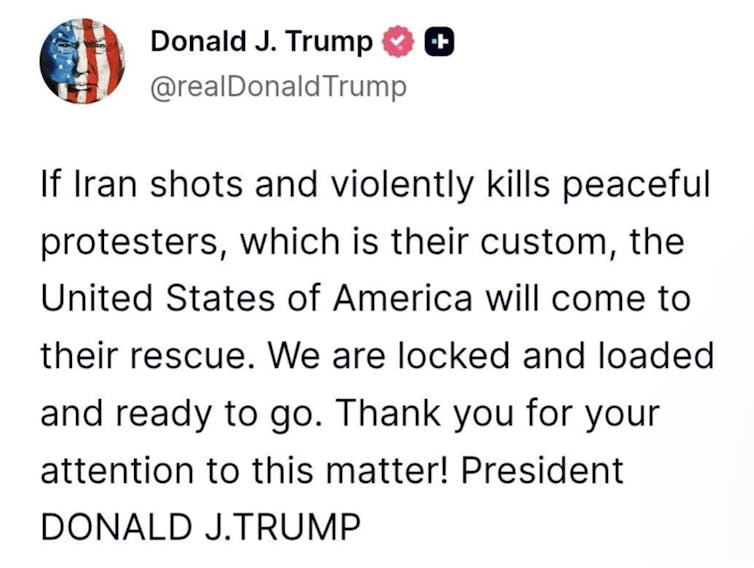
Donald Trump posts on his Truth Social media platform in response to the protests in Iran.
Post-war paralysis
The protests come six months after Iran鈥檚 brief but destabilising war with Israel. This conflict severely strained the state鈥檚 capacity to govern, with Khamenei largely withdrawing from public view since then due to heightened fears over his safety. Major decisions in Iran require Khamenei鈥檚 approval, so his absence has slowed decision-making across the system.
The effects of this have been felt nationwide. Universities and schools have been hampered by repeated closures, shortened schedules and the sudden suspension of in-person classes. Transport networks have faced repeated disruption and economic planning has become nearly impossible.
Prices are . The official annual inflation rate stands at around 42%, with food inflation exceeding 70%. The prices of some basic goods have reportedly risen by more than 110% compared with a year ago, and are further in the coming weeks.
Iran鈥檚 authorities have also intermittently suspended routine daily and weekly activities since the end of the war, such as school days, public office hours, transport services and commercial operations. They , pollution or security concerns as the reasons for doing so.
Underlying these disruptions is a governing system braced for the possibility of renewed war, either with Israel or possibly the US. The regime is operating in a prolonged state of emergency, which has pushed Iranian society itself deeper into crisis.
Iran鈥檚 governing paralysis has been strained further by intensifying competition within the ruling elite. The war with Israel led to the deaths of several senior Iranian military and security figures, which has created gaps in networks of power.
With authority fragmented, rival political, military and security factions have sought to position themselves for influence in a post-Khamenei order. Networks associated with figures such as former president Hassan Rouhani, former foreign minister Javad Zarif and current president Masoud Pezeshkian are pursuing negotiations with western powers to address Iran鈥檚 foreign policy challenges.
But others appear to be engaging in talks aimed at securing backing from ideological allies such as Russia and China. These include people in security and intelligence circles, along with figures ideologically aligned with Khamenei like his second-eldest son Mojtaba, current speaker of parliament Mohammad-Bagher Ghalibaf and conservative clerics such as .
These rival strategies have not produced coherent governance. Instead, they have reinforced perceptions among the Iranian public that the system is preoccupied with survival rather than addressing everyday breakdowns in basic administration, public services and economic coordination.
Iran stands at a crossroads. One path leads toward deeper militarisation, elite infighting and prolonged paralysis. The other points towards a reckoning with a political order that large segments of Iranian society no longer believe can deliver stability or welfare.
The protests suggest that the central question for many Iranians is no longer whether the system can be repaired, but whether continuing to live under it is viable at all. What is clear is that Iran is at a critical political moment, with significant changes likely to unfold in the weeks and months ahead.
, Research Fellow at the Global Development Institute
This article is republished from under a Creative Commons license. Read the .