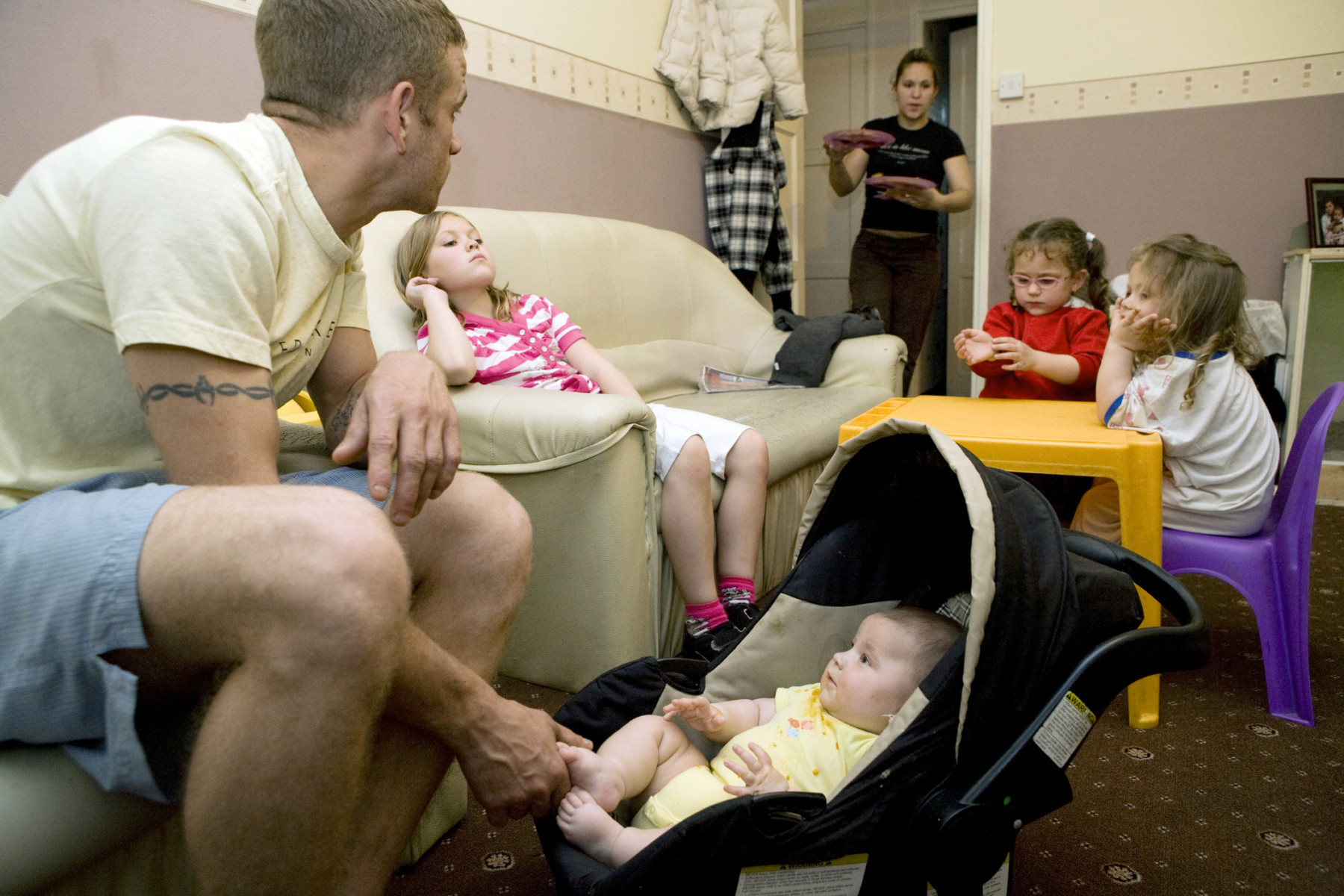
Today's housing emergency is nearly 200 years in the making, says new report
Many of the problems facing the more than 134,000 households living in temporary accommodation in England today - including more than 176,000 children - are part of a pattern of failure stretching back nearly 200 years, according to a major new report.
The research reveals that poor conditions, lengthy stays, placements far from schools, work and support networks, fragmented responsibility and weak accountability have been recurring features of England's temporary accommodation system across generations.
Written by Dr Jessica Field from 51福利社 and published by homelessness charity Justlife, the report traces the development of temporary accommodation from the Victorian Poor Law workhouse system to the modern homelessness system.
Drawing on extensive archival research, parliamentary records, case law and historical accounts, it argues that many practices often presented as contemporary policy failures are in fact longstanding features of temporary accommodation provision, challenging the idea that the current situation represents a sudden departure from an otherwise effective system.
Key findings
Temporary accommodation has existed in different forms for nearly two centuries
Many of the problems seen today have deep historical roots
Poor conditions, lengthy stays and placements away from communities have been repeated over time
Fragmented responsibility has consistently made accountability difficult
People living in temporary accommodation have often had limited opportunities to challenge poor conditions or unfair decisions
Temporary accommodation has frequently operated outside the standards expected of other forms of housing
A new enforceable framework is needed to ensure temporary accommodation is short, safe and healthy
A crisis with deep historical roots
The report identifies a long-running pattern in which certain groups have faced greater barriers to support than others, rooted in ideas about who is considered 鈥榙eserving鈥� of assistance.
It argues that while major reforms have changed the legal framework around homelessness, longstanding patterns of exclusion, unequal treatment and poor-quality accommodation have repeatedly reappeared in different forms.
The research also highlights how fragmented responsibilities across government departments, local authorities and providers have often made it difficult to identify poor practice, enforce standards or learn from successful approaches.
Lessons from nearly 200 years of history
The report calls for three major reforms:
Make unequal harms visible - better monitoring is needed to understand who is being placed where, in what conditions and for how long, enabling policymakers to identify and address unequal outcomes.
End fragmentation - temporary accommodation requires clearer statutory coordination, stronger oversight and greater accountability across the system.
Create an enforceable framework - temporary accommodation should be subject to baseline national standards, backed by meaningful enforcement.
Better temporary accommodation is possible
The report also identifies examples showing that better temporary accommodation can be delivered when there is political will and investment.
One example is the 1944 Temporary Housing Programme, which funded more than 150,000 prefabricated bungalows following the Second World War. Designed with comfort, privacy and family life in mind, the programme demonstrated that temporary accommodation could provide safe and dignified housing rather than merely emergency shelter.
What the researchers say
"Many of the problems experienced by people living in temporary accommodation today have appeared again and again for nearly two centuries,鈥� said Dr Jessica Field. 鈥淲hat emerges from this research is a story of recurring patterns rather than isolated failures - poor conditions, long stays, family disruption and displacement from communities have persisted across very different political and policy contexts. Understanding how these problems developed helps us see why piecemeal reforms have often struggled to deliver lasting change.鈥�
"If temporary accommodation is to become the short-term, safe and healthy support it is intended to be, we need to address the deeper structures that have repeatedly produced poor outcomes."
"Temporary accommodation may seem like a current crisis, but it has been part of our lives for nearly 200 years - yet the experience for many people living in temporary accommodation today remains painfully similar to what it was in the nineteenth century,鈥� said Simon Gale, Chief Executive of Justlife.
"Poor conditions, long stays, people being moved away from their communities, and families left in uncertainty are not new problems. Lifelines shows they are part of a much longer pattern. That matters because we cannot keep responding to temporary accommodation as if each problem is new, isolated or unavoidable.鈥�
"If we are serious about ending the harm caused by temporary accommodation, we need a clear national framework, proper standards, stronger accountability and a housing policy that stops temporary solutions becoming long-term realities."
Publication
was authored by Dr Jessica Field and published by Justlife.